Bypassing Google Play & App Store Fees: Mitigating Policy Compliance and User Drop-Offs
Aug 06 2026・7 mins

TL;DR
- Recover more revenue and reduce reliance on iOS and Android platform fees that traditionally takes up to 30% in platform fees.
- Create compliant link-outs with Coda Links, using smart deep-linking to pass Player IDs, SKUs, and purchase context automatically.
- Preserve brand trust and deliver a fully branded checkout that feels like a natural extension of the product with Coda Webstore.
- Paired together, publishers can avoid customer drop-offs through payment solutions that ensure seamless and secure checkouts.
Why Are Digital Publishers Moving Transactions Out of the App?
Digital content publishers traditionally relied on app platforms like iOS App Store and Google Play Store for distribution and payments. In return, they historically charge platform fees up to 30%. At scale, losing nearly one-third of gross top-line revenue directly restricts capital that could otherwise be reinvested into:
- User Acquisition (UA) and performance marketing campaigns.
- LiveOps, content development, and feature updates.
- VIP loyalty programs and direct player rewards.
- Regional expansion across emerging high-growth markets.
Shifting from these app platforms can improve margin control and create a more direct relationship with customers. But it also introduces an important UX challenge: Will users trust the journey enough to complete their purchase after leaving the app?
The common assumption is that external checkout automatically creates friction, weakens conversion, and causes drop-off. In practice, the problem is rarely the web itself. Conversion suffers when users encounter an unfamiliar interface, lose their cart, or face an unexpected redirect.
Reclaiming Margin Control From Traditional App Stores
Global regulatory shifts and anti-steering policy updates, most notably the Digital Markets Act (DMA Article 5(4)) in Europe alongside link-out mandates in major international jurisdictions, have granted publishers explicit legal rights to present external offers to users. However, regulatory permissions alone do not eliminate operational complexity. Publishers navigating direct monetization must still manage region-specific entitlement rules, platform API integrations, and mandatory transaction reporting.
| TRADITIONAL IN-APP BILLING | OUT-OF-APP D2C STOREFRONTS |
|---|---|
| ❌ Up to 30% Platform Commissions | ✅ Maximized Margin Retention |
| ❌ Restricted Customer Data Access | ✅ 1st-Party Player Data Ownership |
| ❌ Static Storefront Merchandising | ✅ Web-Exclusive VIP LiveOps |
| ❌ Platform-Controlled Payments | ✅ 400+ Localized APMs via Codapay |
The true commercial objective is not simply replacing in-app billing with a basic web page. It is about deploying a flexible D2C commerce architecture that remains compliant with evolving platform terms while giving publishers total control over pricing, branding, customer data, and payment execution.
Does Redirecting Users to a Webstore Cause Conversion Drop-Off?
Not inherently. Users already move between applications, browsers, and authentication screens throughout their daily digital experiences. The redirect itself is not necessarily the problem.
The 5 Main Causes of Out-of-App Checkout Abandonment
- Forced Re-Authentication: Requiring players to manually re-enter usernames, passwords, or complex Player IDs.
- Domain Disconnect: Redirecting users to an unfamiliar third-party URL or unbranded checkout page.
- Broken Cart Context: Losing the specific SKU, bundle, or promotional discount selected inside the app.
- Payment Method Mismatch: Offering only credit cards in markets dominated by localized e-wallets or bank transfers.
- Latency & Mobile Misalignment: Slow-loading web pages that are not optimized for mobile browsers.
The 4 Pillars of a Frictionless Out-of-App Journey
These issues are architectural. They can be addressed through deliberate UX design. The objective now is to preserve continuity across four areas:
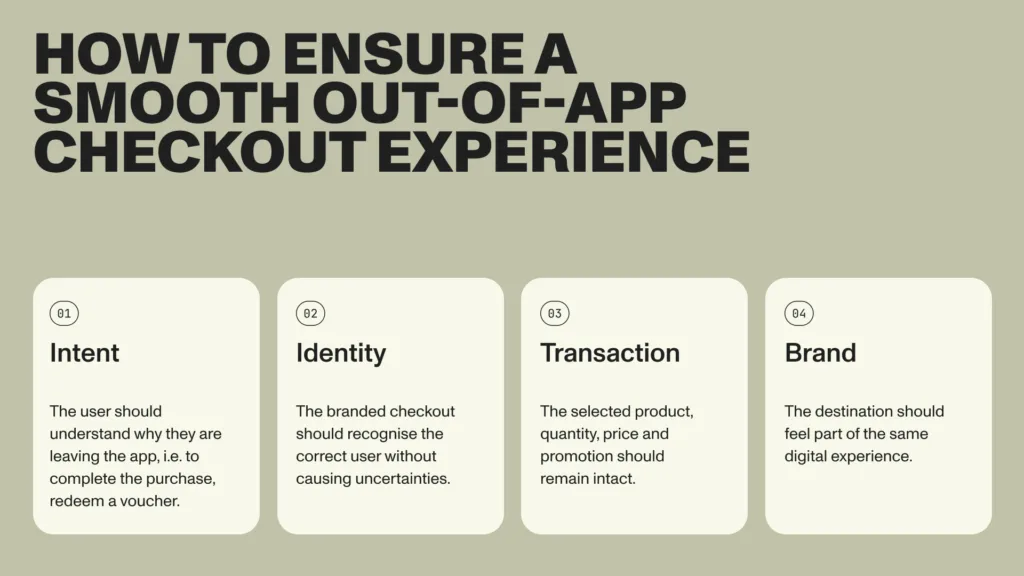
When these elements persist, the web checkout becomes the next step in the journey rather than a separate purchasing environment. The external webstore or page should instantly confirm that they are still dealing with the same brand. The target environment should preserve:
- Brand colours
- Logos
- Product artwork
- In-app terminology
- Currency formatting
- Support language
- Tone of voice
Streamlining the Out-Of-App Experience With Coda
Coda Webstore is a fully branded checkout that reassures customers that their journey is intentional and secure. White-label customization also allows publishers to build the webstore around their own brand. That way, publishers can tailor the storefront’s visual identity, product merchandising, and checkout experience to match.
Once a publisher completes their D2C storefront, they can launch an external checkout rather quickly, through dedicated payment links such as Coda Links. Connecting a specific in-app offer directly to a secure web checkout, preserving the product and user context required to complete the transaction. This makes link-outs useful for:
- Individual SKUs
- Limited time bundles
- Subscription upgrades
- Regional campaigns
- Testing external checkout demand
Put the two together, it can form a rather powerful strategy for out-of-app monetization. Coda Webstore and Coda Links provide a clear opportunity for publishers to retain margin and return it to other aspects of the business such as content development and product updates. Coda Links can direct users out-of-app, while Coda Webstore provides the larger branded environment in which payment and loyalty mechanics are managed.
Managing Global Liabilities for Out-Of-App Checkouts
Behind the branded webstore and link-outs, publishers must still manage payment acceptance, taxation, regulation, fraud, and settlement across multiple jurisdictions.
Without the right infrastructure, shifting transactions out of the app can transfer operational risk from the marketplace to the publisher. This is why a D2C webstore should not be evaluated only as a front-end development project.
Under a Merchant of Record (MoR) model, Coda acts as the legal seller of digital goods. Coda assumes 100% liability for:
- Global Tax Calculation & Remittance: Calculating and filing local sales tax, VAT, and GST across 70+ markets.
- Payment Localisation (Codapay): Providing instant access to 400+ local payment methods—including e-wallets (e.g., GCash, GoPay, KakaoPay), direct carrier billing (DCB), and local debit cards—where credit card penetration is low.
- Fraud & Chargeback Protection: Absorbing financial liability for fraudulent transactions and disputed chargebacks.
- FX & Cross-Border Settlement: Handling currency conversions and cross-border payout logistics.
This infrastructure allows publishers to scale globally without establishing local legal entities or assembling fragmented networks of payment and tax vendors.
Build a Branded D2C Journey With Coda
Marketplace rules will continue to change. Entitlements, commissions, disclosure requirements, and more may differ substantially between platforms and regions. A direct commerce channel gives publishers an infrastructure they can adapt as those rules evolve. The objective is to create an owned commercial relationship that remains consistent across applications, devices, platforms, and markets.
And with the right architecture, users can move from a native application into a secure checkout. Coda brings together the components needed to deliver that journey:
- Coda Webstore for a fully branded D2C storefront
- Coda Links for secure, data-rich out-of-app routing
- Merchant of Record services for managed tax, fraud, chargeback, FX, and regulatory responsibilities
Together, these capabilities turn out-of-app migration into a scalable growth strategy.
Grow with Coda. Sign up now.
Frequently Asked Questions (FAQs)
Related
© 2026 Coda Payments Pte. Ltd
Site Credits