Out-of-App Payment Platforms Built for Mobile-First Users: A Complete Guide
Sep 11 2026・6 mins
TL;DR:
- Out-of-app payment platforms help publishers reduce app store billing and build a direct checkout.
- Coda Links preserve Player IDs, selected SKUs, and purchase context as users move to a separate checkout page.
- Codapay supports 400+ payment methods, while Coda’s built-in Merchant of Record model manages payments, taxes, fraud, and regulatory obligations.
- Coda Webstore turns out-of-app traffic into repeat purchases through branded storefronts, LiveOps, and loyalty programs.
What Is an Out-of-App Payment Platform?
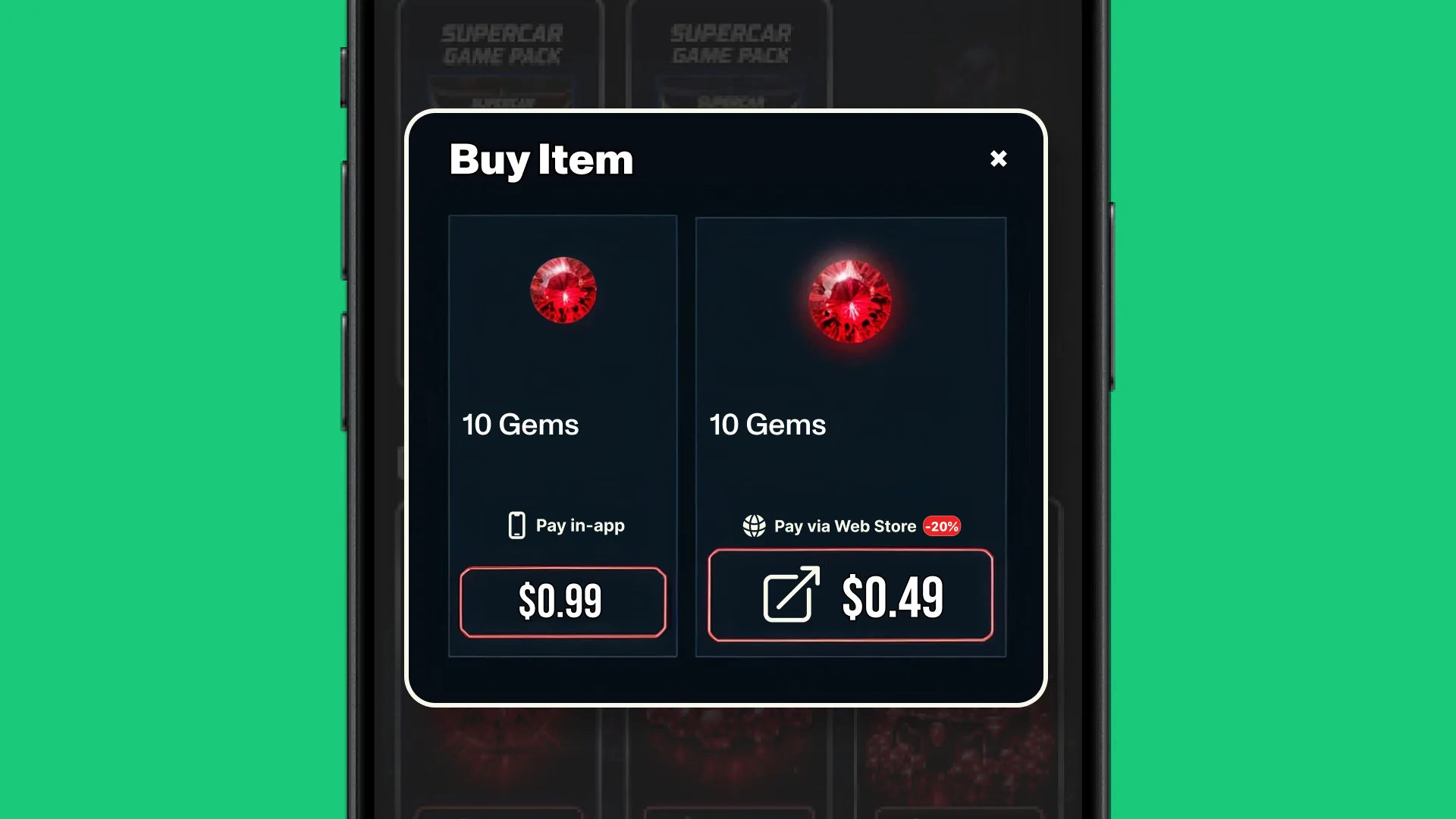
An out-of-app payment platform connects a native application to an external checkout where users can purchase digital content, subscriptions, top-ups, or in-game currency. It is a direct-to-consumer (D2C) monetization strategy for publishers who want to reduce reliance on traditional app store billing that takes 15% to 30% to improve margin control and build a more direct customer relationship.
Unlike a conventional payment gateway, it must support the complete mobile commerce experience. This includes preserving the user’s identity, carrying their selected SKU into the checkout, accepting locally preferred payment methods, confirming payment, and delivering the purchase to the account instantly.
That is the goal for most publishers or developers who want to benefit from out-of-app monetization.
How to Route Users Out of the App Without Drop-offs?
App-to-web transitions can create friction when the user’s session and purchase context do not carry over. If players must manually enter their ID, log in again, or search for the item they selected, every additional step creates another opportunity for abandonment.
Coda Links uses smart deep-linking to preserve the technical context required for the purchase.
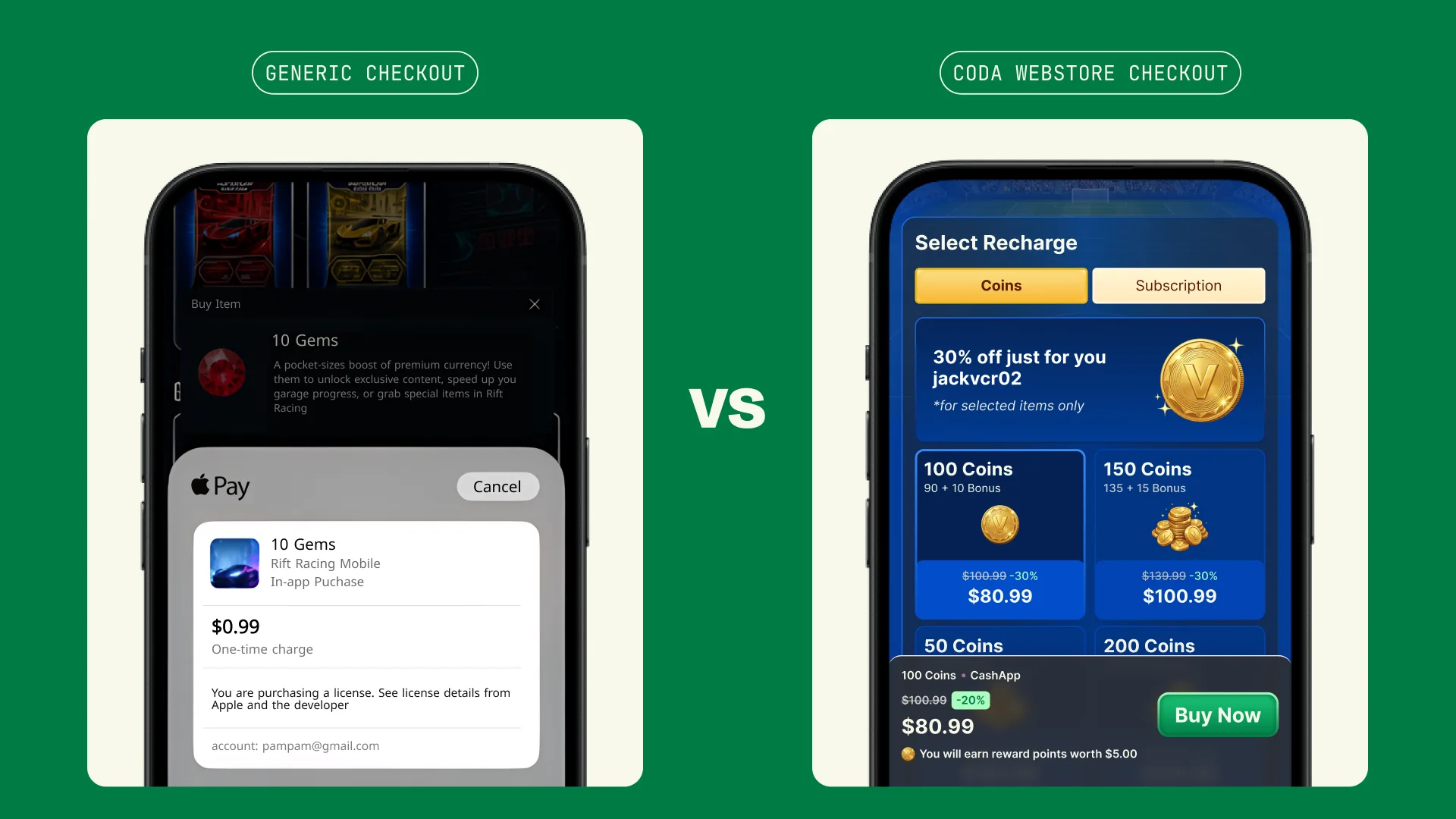
Publishers can pass parameters such as User/Player ID, selected SKU, session information, and purchase context directly into the external flow. Instead of arriving at a generic homepage, the user can be routed to a relevant product or offer. This reduces manual input and allows the checkout to recognize what the user intended to purchase.
Coda Links can also support market-specific flows based on applicable platform requirements. Link-out rules vary across the EEA, US, and APAC. Learn more about reducing friction and maintaining compliance during app-to-web transitions.
Convert Mobile Users with Regional APMs and E-wallets
A smooth redirect does not guarantee conversion. Once users reach the checkout, they still need a payment method they recognize and can access.
This is especially important in mobile-first markets across APAC, LATAM, and MENA. Many consumers rely on e-wallets, real-time bank transfers, local cards, or direct carrier billing rather than international credit cards.
Traditional app store billing may not support the full range of regional payment methods used in these markets and a card-heavy external checkout can recreate the same limitation, even if the user arrives with strong purchase intent.
Codapay addresses this payment gap through direct integration with more than 400 local and global payment methods. These include leading regional payment options such as:
- GCash in the Philippines: A widely used mobile wallet that allows customers to pay without an international credit card.
- GoPay in Indonesia: A familiar e-wallet embedded in the country’s mobile-first digital economy.
- Pix in Brazil: A real-time account-to-account payment method designed for fast local transfers.
- Direct carrier billing: An accessible option that allows eligible customers to charge purchases to their mobile account.
Through a single backed API, publishers can offer payment options that reflect how customers already transact in each market. This reduces the need to build and maintain separate integrations with different payment providers.
Localized payment experiences also extend beyond just showing additional logos at checkout. The experience accounts for local currencies, mobile redirects, authentication flows, confirmation, and fulfilment requirements. Codapay brings these components together in a mobile-optimized checkout designed for digital content.
Offload Global Payment & Tax Complexity with a Merchant of Record
Each new market can add different requirements for VAT, GST, sales tax, refunds, chargebacks – the list goes on when expanding into new regions. Managing these obligations internally can require local entities and multiple specialist vendors.
Under Coda’s built-in Merchant of Record, Coda acts as the legal seller for the transaction that takes responsibility for the financial and regulatory aspects. These include:
- Calculating and remitting applicable transaction taxes
- Managing localized payment processing
- Handling fraud and chargeback exposure
- Supporting refunds and payment disputes
This allows for teams to focus on other functions such as the content, user journey, or loyalty programmes.
Turn Out-of-App Checkout Into a Retention Channel
Coda Links, Codapay, Merchant of Record all play an important role for out-of-app monetization. To elevate that experience even further is to give publishers a branded destination for the traffic generated through apps or marketing.
Instead of directing every user to a basic payment page, Coda Webstore creates a branded payment environment with exclusive bundles, loyalty points, VIP tiers, daily rewards, and more. Combined with its AI-powered builder, it can generate an initial webstore within minutes using just an app store link from Apple App Store, Google Play, or Steam. This reduces the design and engineering effort to establish a D2C channel immensely.
Together, these solutions support the full mobile commerce journey. Publishers can route users from the app, preserve purchase context, offer trusted regional payment methods, deliver the purchase, and give customers a reason to return.
Out-of-app payment execution is not simply a question of where a transaction takes place. It depends on how smoothly a user reaches a branded and secure checkout, whether they can pay using a familiar method, and how reliably the transaction is managed afterward.
Coda connects these capabilities in one infrastructure layer, helping publishers build mobile-to-web payment journeys that are localized, scalable, and designed to convert.
Keen on exploring what Coda can do for you? Find out more
Frequently Asked Questions (FAQs)
A player clicks an in-game offer and is directed to an external webstore through a smart deep link. Coda Links securely carries the player’s ID, selected SKU, and purchase context into the checkout, removing the need to enter a long Player ID manually. Once payment is confirmed, the publisher’s system delivers the digital goods directly to the in-game account.
In eligible markets, out-of-app platforms allow developers to direct users to external purchases instead of relying on app store billing. This is supported by developments such as the Epic v. Apple ruling in the US and the EU’s Digital Markets Act. Publishers can therefore reduce their exposure to traditional commissions of up to 30%.
Coda’s out-of-app infrastructure runs on transparent, published pricing. Coda Webstore starts at 5% per transaction, and Coda Distribution offers a flat 15% per transaction, both well below the up-to-30% commissions charged by traditional app store billing. Full pricing details are available here.
A payment gateway provides just the technical connection needed to process a transaction. A Merchant of Record such as Coda acts as the legal seller for the transaction and manages compliance and regulations on the publisher’s behalf, including tax calculation, remittance, chargeback management, and more.
Related
© 2026 Coda Payments Pte. Ltd
Site Credits