Beyond the Bank: Why Gaming is the Ultimate Gateway for Global Financial Inclusion
Jul 30 2026・4 mins
On August 1st, World Fintech Day marks the death anniversary of Cosimo de’ Medici, the 15th-century banker credited with founding modern banking. It’s a fitting date to take stock of how far financial access has come, and how far it still has to go. For game publishers, that gap isn’t abstract: you’re not just running games, you’re building the financial infrastructure that lets underbanked players access the global digital economy for the first time.
That’s the paradox at the heart of mobile gaming. Games are sophisticated, global entertainment products. But they run in regions where the financial infrastructure behind a “simple” purchase was never built for the average player.
Where Traditional Banking Falls Short
Banking hasn’t kept pace with mobile gaming’s growth in emerging markets, and the gap is structural, not incidental.
Only 13% of mobile gamers in Southeast Asia use credit cards. In Japan and Korea, just 4.9% of players use debit cards. Layer on top of that: over 100 countries now enforce remote VAT/GST rules for digital merchants, adding compliance weight to every new market you enter.
If your checkout only runs on app store rails built around credit cards and global banks, you’re locked out of the fastest-growing player base in the world.
Localize the Funnel, Widen the Reach
Every gaming marketing funnel, awareness, acquisition, and purchase, is also a fintech access funnel. How players pay determines who gets to play.
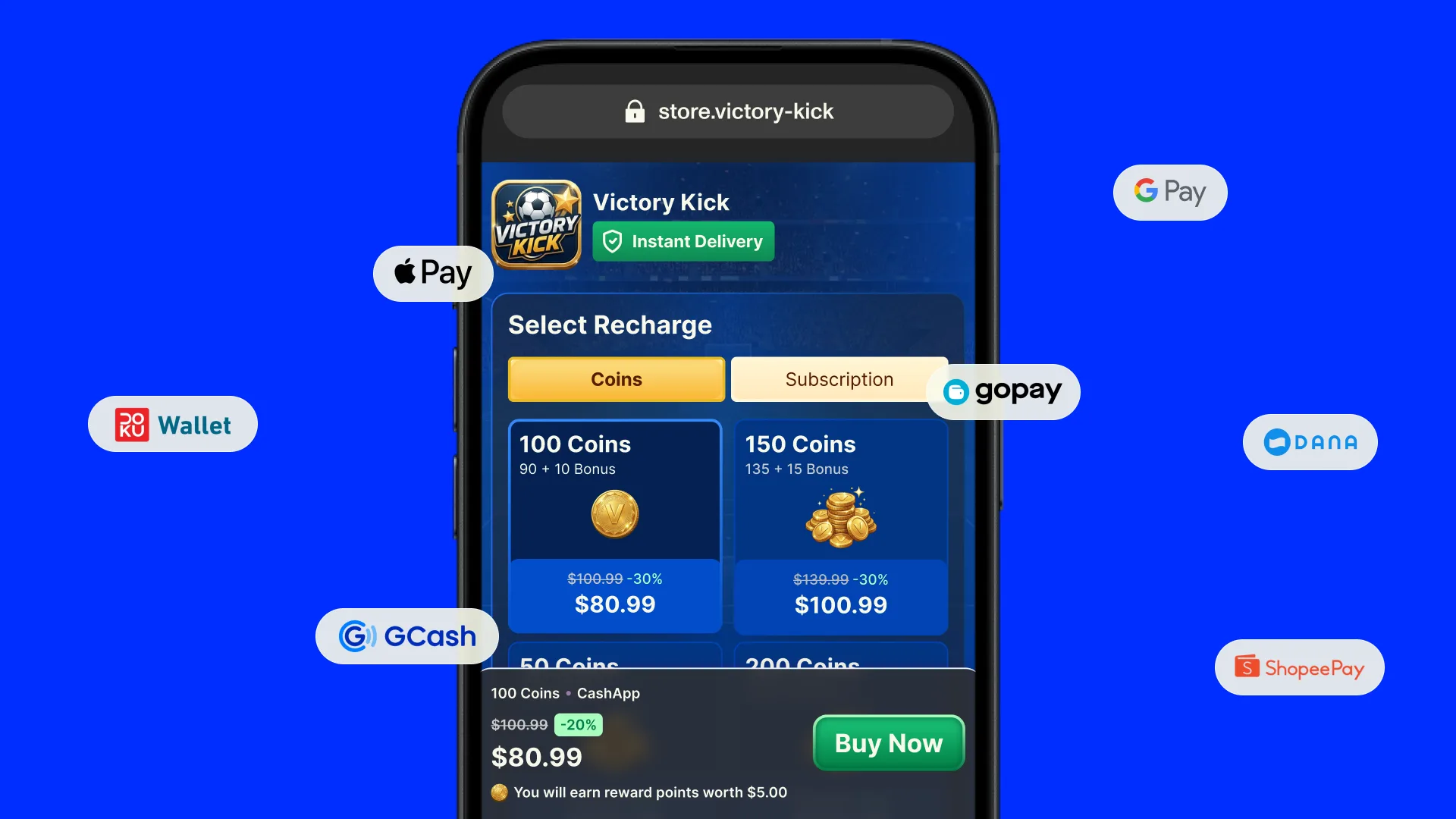
In Southeast Asia, 55.1% of gamers rely on local e-wallets like Dana, GCash, and OVO. Another 24.8% pay through direct carrier billing. Widening your funnel means localizing checkout. Plug into a platform like Codapay, and you’re instantly offering up to 18 local alternative payment methods in a single market, turning your checkout into a localized fintech portal instead of a bottleneck.

Subscriptions Are the Next Frontier
Fintech is shifting from one-off purchases to recurring relationships. Battle passes and monthly memberships used to live and die on credit cards. That’s changing. Recurring payments via e-wallets and direct debit are opening premium, subscription-based content to players who never had a credit card to begin with.
This shift makes premium, recurring content accessible to a broader user base without credit cards. The global prepaid card market backs that up: valued at $3.4 trillion in 2025 and projected to reach $7.1 trillion by 2035.
For publishers, that means predictable, loyal revenue in markets you may have written off as low-value, purely because of card scarcity. Coda has already seen this play out: one Codashop web store went from 20,000 to 200,000 daily payments in six months, no credit card required, outpacing app store transactions in the same window.
Designing the Choice: The Conversion Playbook
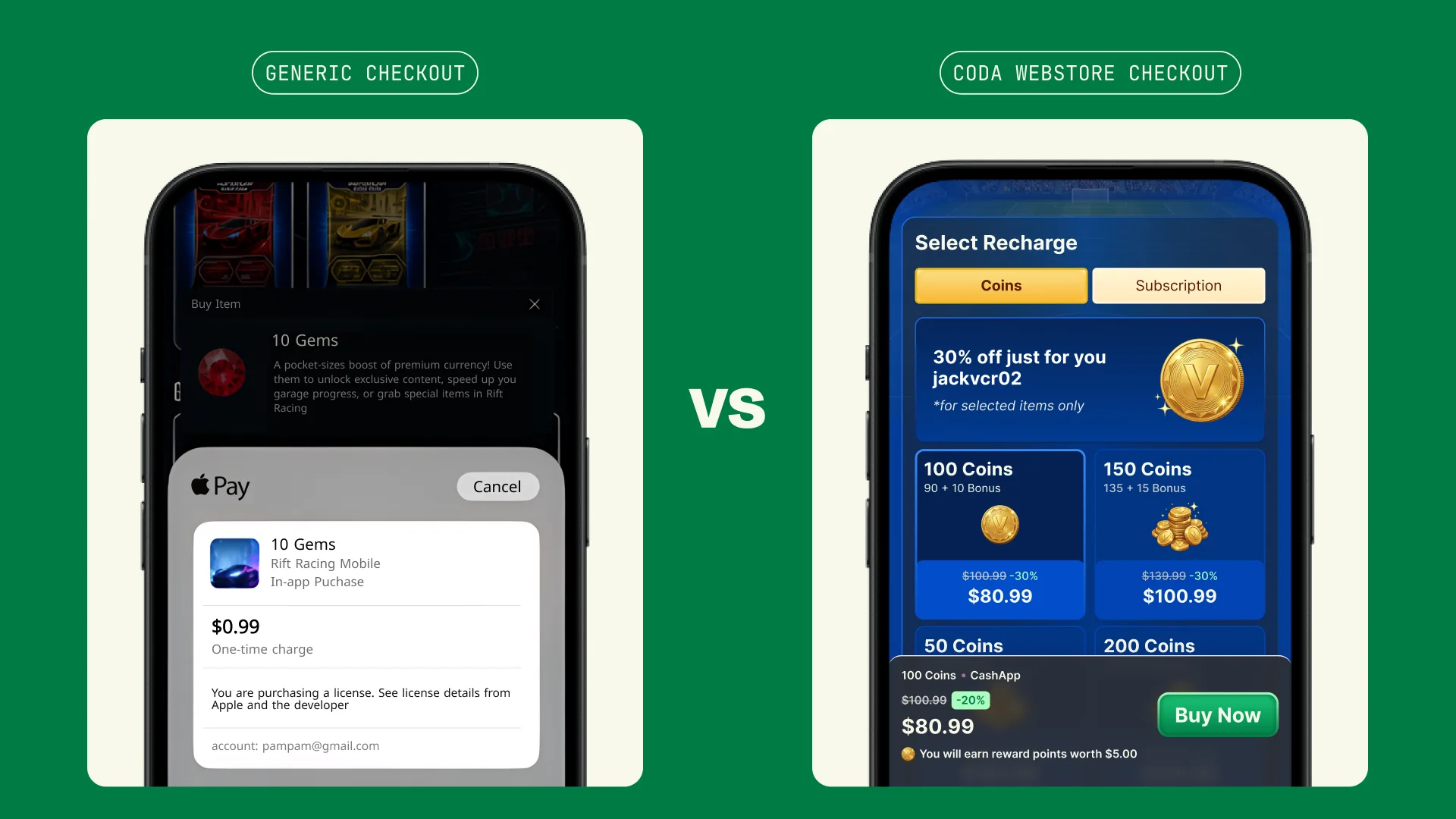
While establishing these fintech portals is a massive step forward for financial inclusion, the practical execution still requires discipline. Out-of-app payments carry more friction than a single in-app tap, so a portion of recovered margin must be returned to the player to clear that friction and prevent drop-off.
To achieve comparable conversion, the out-of-app offer must carry enough additional value to convince the player that the extra steps are worth taking.
Publishers should customize the player journey based on user behavior:
- Segment by Propensity: Save linkout invitations for highly engaged, high-level players or those with established purchase histories. Avoid interrupting casual players attempting fast, impulsive, low-value purchases.
- Highlight the Value: Place your in-app and out-of-app options side by side. Visually emphasize the web store advantage by showing a larger pile of currency, a lower price point, or added benefits like web store loyalty points.
The Democratization of Digital Commerce
On World Fintech Day, the real story of financial technology is about democratizing access in emerging markets. Coda acts as the silent engine behind this democratization.
Behind the scenes, a sustainable out-of-app engine requires payment routing, fraud protection, local tax compliance, and reconciliation across every territory you operate in. Build that chain in-house, and your recovered margin is quickly consumed by operational overhead.
Coda closes these gaps end-to-end. Codapay routes over 400 payment methods to the right player in the right market. As Merchant of Record, Coda absorbs the tax and compliance burden so you don’t have to build it in-house. And whether players buy through their own branded storefront on the Coda Webstore, an established marketplace like Codashop, or reach new audiences through Coda Distribution, the underlying infrastructure stays the same: built for the players’ banks that were left behind. That leaves publishers free to do what they do best: creating great games we already love.
Learn how to design a high-converting web storefront that scales globally.
Download Coda’s latest white paper: Beyond the App Store: A Publisher’s Guide to Direct Linkouts and Out-of-App Monetization
Related
© 2026 Coda Payments Pte. Ltd
Site Credits