Why Horizontal E-Commerce Platforms Fall Short for Digital Content (And How Dedicated Infrastructure Unlocks D2C Growth)
Sep 03 2026・5 mins
TL;DR:
- Out-of-app monetization allows mobile game publishers, content creator apps, and digital platforms to sell virtual items, top-ups, and subscriptions directly to consumers via web checkouts to bypass 15%–30% app store fees.
- Standard e-commerce platforms can support digital content, but their default carts, plugins, and payment setup are built around general ecommerce rather than fast, repeat digital purchases.
- Selling digital goods globally creates tax and regulatory obligations that a basic payment gateway does not take over.
- Coda brings together a purpose-built webstore, Merchant of Record infrastructure, 400+ payment methods, LiveOps tools, and seamless link-outs.
What Is Out-of-App Monetization and Why Does It Matter?
These days, a game can sell virtual currency through a branded webstore. A creator platform can offer credits outside the app. A dating service can sell premium features on the web, while a SaaS company can direct users to a browser-based recurring flow.
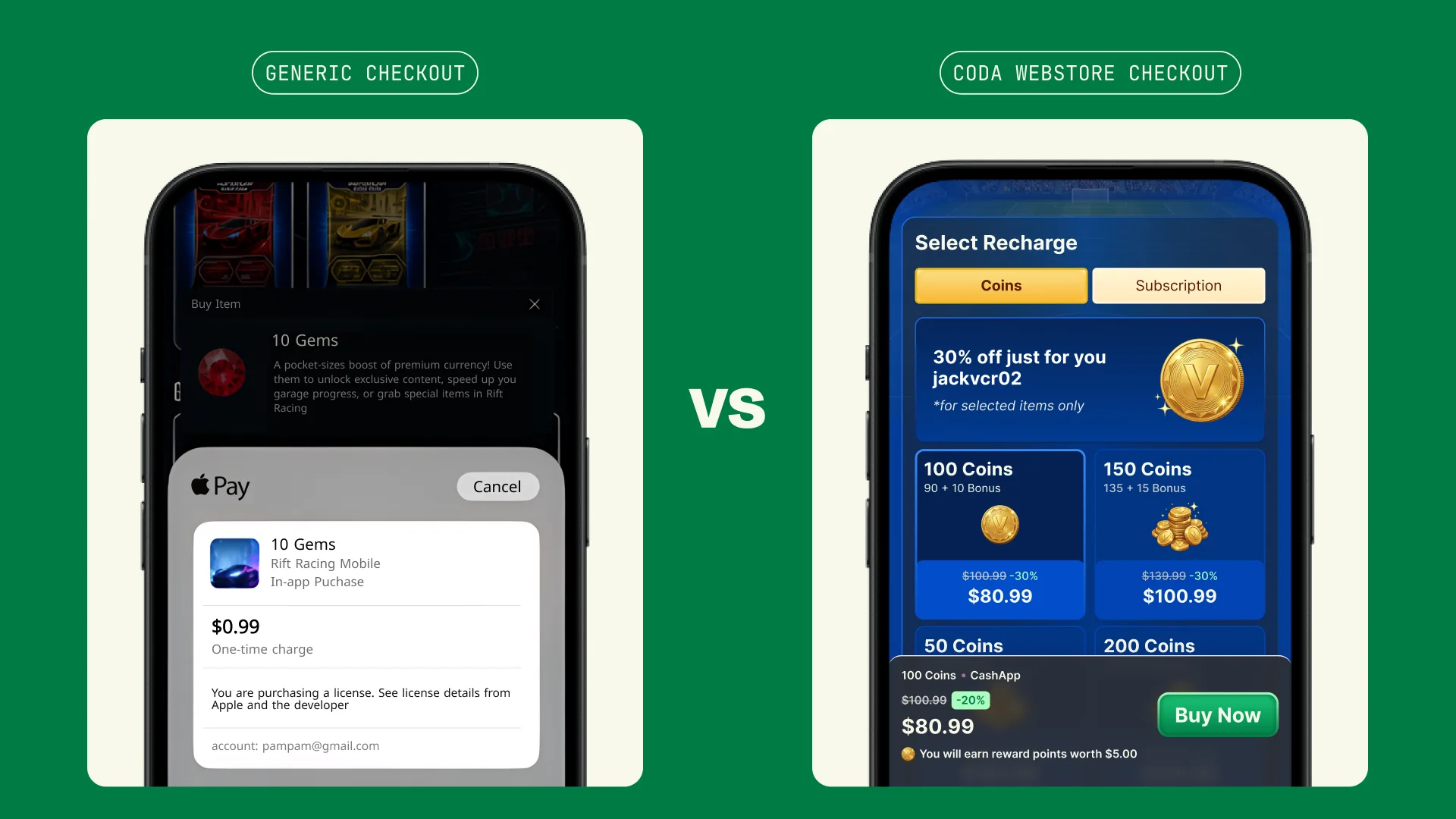
This direct-to-consumer (D2C) strategy is out-of-app monetization: it refers to transactions completed outside a native mobile app, usually through a webstore or web-based checkout. It gives digital publishers full control over branding, pricing, LiveOps promotions, and customer relationships while bypassing 15%–30% platform commissions.
A successful out-of-app channel requires specialized infrastructure:
- Context Preservation: Moving users from app to browser without re-login friction.
- Instant Entitlement: Validating account parameters (e.g., Player ID) and delivering digital assets instantly.
- Localized Checkout: Offering non-card alternative payment methods (APMs) preferred in emerging mobile markets.
- Regulatory Compliance: Adhering to regional link-out policies, anti-steering mandates, and Digital Markets Act (DMA) guidelines.
Our guide to out-of-app link-outs, policy compliance, and checkout conversion explains how a well-designed journey can reduce common causes of drop-off.
Why Horizontal Retail Platforms Fall Short for Digital Content
Platforms such as Shopify, WooCommerce, and Wix are general-purpose ecommerce tools. They make it possible for a broad range of businesses to create online stores, and each can be adapted to sell digital products. However, the issue is fit, not basic capability.
When applied to high-frequency digital microtransactions, their core architecture creates severe conversion bottlenecks:
1. Physical Cart Friction
Multi-step carts requiring physical billing and shipping addresses increase bounce rates for microtransactions. Generic landing pages cannot pass user sessions, forcing users to manually log in and re-select their in-game items.
A digital webstore must connect the payment event with user identity, server region, and item SKU data instantly. Using Coda Links, publishers leverage smart deep-linking to pass technical parameters (Player ID, SKU) seamlessly from the app to the web checkout, triggering instant item delivery upon payment confirmation.
2. The Non-Card Payment Gap
In mobile-first regions across APAC, LATAM, and Africa, credit card penetration is low. Mobile users buy digital goods using localized e-wallets (e.g., GCash in the Philippines, GoPay in Indonesia, Pix in Brazil) or direct carrier billing.
3. Plugin Fragility
Standard payment gateways on retail platforms usually require separate backend API integrations, settlement reconciliation, and refund logic for every regional payment provider. Codapay solves this by granting instant access to 400+ local payment methods across 70+ markets through a single API integration.
Horizontal Retail Platforms vs. Coda
The most useful comparison is not whether each option can create a page that sells something. It is how much of the digital commerce journey each option supports without additional infrastructure.
| Area | Horizontal Retail Platforms (Shopify, WooCommerce) | Coda Products (Coda Webstore, Codapay, Coda Links & more) |
|---|---|---|
| Primary use case | Broad ecommerce across physical and digital products | Digital content, game currencies, top-ups, subscriptions, and other account-based purchases |
| Store creation and setup | Template-led setup, digital use cases may require apps, plugins, or custom development | AI-powered storefront generation using existing app or game data, with a customizable branded experience |
| Checkout and fulfilment | General cart and order workflows; account-level digital fulfillment may require customization | Digital-first purchase paths connected to user IDs, SKUs, offers, payment confirmation, and entitlement workflows |
| Tax and compliance | Tools may calculate tax, but the publisher generally remains responsible for registration, filing, remittance, and liability | Built-in Merchant of Record model can manage tax, fraud, chargebacks, refunds, and key regulatory responsibilities |
| Out-of-app journeys and routing | Standard URLs and landing pages; app-to-web context passing usually requires custom work | Coda Links supports secure link-outs that can preserve user, SKU, and promotional context in eligible markets |
| Alternative payment methods | Coverage depends on the chosen gateway, extensions, and market availability | 400+ local and global payment methods across 80+ markets worldwide through Codapay |
| LiveOps and loyalty | General promotions and discount tools; game or app-specific mechanics often require extensions | Built-in tools for personalized offers, bundles, purchase limits, daily rewards, loyalty programs, and VIP tiers |
Horizontal platforms are a sensible choice for many retail businesses and simpler digital catalogs. The gap becomes more visible when a publisher needs rapid repeat purchases, real-time engagement delivery, app-to-web continuity, market-specific payments, and global liability management at the same time.
Build for Digital Commerce, Not Just Ecommerce
Out-of-app monetization is not simply a matter of moving a checkout into a browser. It is the creation of a direct commerce channel that must connect various parts to complete a successful transaction.
General retail platforms may provide a starting point, but digital publishers often have to assemble the rest of that stack themselves. Coda brings the layers together; providing a branded storefront and LiveOps environment, localizing payment acceptance, and managing operational responsibilities for market expansions.
The result is an out-of-app channel built around how digital products are discovered, purchased, delivered, and repurchased.
Ready to build your out-of-app strategy? Get started with Coda.
Related


© 2026 Coda Payments Pte. Ltd
Site Credits