Distribution Beyond D2C: Growth Playbook for Game Publishers
Oct 16 2026・7 mins
TL;DR: For game publishers, distribution to third party stores adds revenue alongside direct-to-consumer (D2C) rather than replacing it. D2C is strongest at converting players who already know your game and intentionally seek out your webstore. Distribution of game top up API extends your reach to players browsing the storefronts, game resellers, payment channels, and platforms they frequent.
Why D2C Alone Leaves Demand on the Table
A strong D2C strategy gives publishers greater control over the purchase experience, customer relationships, pricing, promotions, and more importantly, margins.
But even a high-performing webstore has a natural limit: players have to reach it first.
Not every potential buyer begins their journey with the game or brand. Some discover it while browsing storefronts or third-party platforms. Others prefer buying through resellers they already trust. In some markets, these reseller games online are already deeply embedded in how players discover game top up, and purchase digital content.
This creates a gap between the audiences publishers can reach directly and the broader pool of potential demand available across the market.
Distribution helps fill that gap.
Instead of replacing a publisher’s D2C channel, distribution places products in additional environments where players are already browsing and spending. The objective is incremental reach: capturing transactions that would be unlikely to happen through the first-party webstore in the first place.
| D2C is strongest when… | Distribution is strongest when… |
|---|---|
| Players already know your game | Players are still browsing or deciding what to buy |
| Users intentionally visit your webstore | Users discover and spend within an existing third-party channel |
| You want direct control of the purchase journey | You want to extend reach beyond owned channels |
| Brand affinity and existing player relationships are strong | Trust from local storefront or reseller influences purchasing |
| Demand already exists and needs to be converted | New audiences or markets need to be reached |
For publishers, the question is therefore less “D2C or distribution?” and more “Where is demand happening that our D2C channel does not currently capture?”
What Incremental Revenue Looks Like in Practice
The clearest measure of a distribution strategy is whether it creates incremental business rather than simply moving existing purchases from one channel to another.
In one market, a leading publisher recorded a 7x revenue growth in six months, powering exponential growth while its D2C revenue remained steady. Rather than cannibalizing its direct channels, Coda distribution expanded its demand across five titles, tapping into audiences they wouldn’t have otherwise reached.
In another case, a leading Asian publisher grew its revenue contribution by 40% through Coda Distribution. Expanding outside of its key markets to 56 countries.
The important point is not simply the scale of increases but where that growth comes from.
A well-designed distribution strategy can reach audiences and purchase occasions that a publisher’s existing D2C channel is not capturing. That makes distribution an additional growth layer rather than a substitute for direct commerce.
Open vs. Managed Distribution
Open distribution means a publisher’s content is sold through many resellers and distributors with minimal central oversight. Managed distribution routes those channels through one operator that sets and enforces the publisher’s rules.
The difference is control. Under open distribution, pricing, promotions, and territories are set partner by partner, so visibility is fragmented and discounting can slip out of the publisher’s hands. Under managed distribution, a single operator applies the publisher’s pricing rules, market restrictions, and compliance requirements across every channel and reports results in one place.
How to Keep Distribution From Undercutting D2C: Six Guardrails
A distribution strategy should be designed around a simple principle: new channels should add demand, not compete with channels that already work.
This requires six core guardrails:
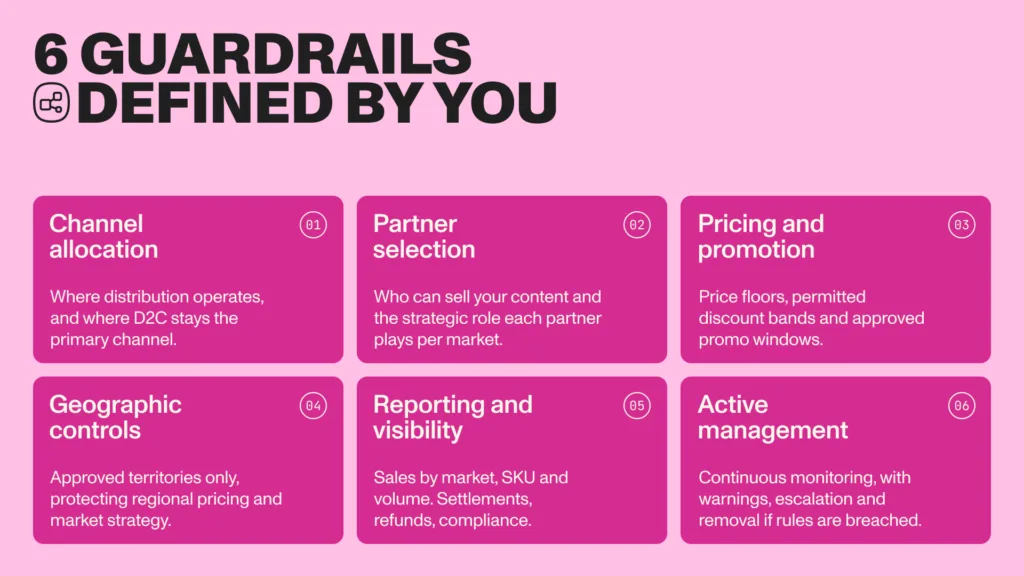
- Channel allocation: Define which products, offers, or audiences belong in D2C and which are better suited to third-party channels.
- Partner selection: Choose partners based on the audiences and markets they can add and fill the gap, rather than maximizing partner count alone.
- Pricing and promotion controls: Set clear rules governing pricing, discounts, and bundles, and promotional activity across distribution partners. Without these controls, aggressive third-party discounting can undercut first-party pricing and train players to buy elsewhere.
- Geographic controls: Allocate partners and offers according to the markets where they can generate more reach.
- Reporting & visibility: Maintain visibility into transaction volume, partner performance, markets, and other channel-level results.
- Active management: Continuously monitor and assess the network and adjust partners, offers, markets, and allocation based on performance.
These controls allow publishers to expand beyond distribution without treating every channel, audience, or market identically.
Our Beyond D2C: Coda’s Guide to Distribution white paper goes deeper into all six core guardrails.
How to Choose a Game Distribution Partner
Once publishers have identified where distribution can add value, the next question is who should provide that reach.
A large partner network may look attractive on paper, but partner count alone says little about whether those channels can reach the right users or can be managed effectively.
Publishers should evaluate potential partners across audience reach and incrementality as well as operational support and active management.
Ask what audience the partner actually adds. A distribution partner is most valuable when it reaches customers who are difficult or expensive to capture through existing channels. This could mean access to a trusted reseller network, a payment ecosystem with an established user base, or a storefront where users actively discover new digital content.
Distribution networks also change over time. Partners perform differently by market and new opportunities may emerge.
Publishers should understand who is responsible for monitoring performance, resolving operational issues, and optimizing the network after launch.
Coda Distribution provides publisher access to a vetted network of distribution partners across global and local channels, with the controls needed to manage how products reach each market. For publishers evaluating potential providers, the Beyond D2C: Coda’s Guide to Distribution white paper includes a complete partner-vetting scorecard that can be used to compare distribution options consistently.
What’s Inside “Beyond D2C: Coda’s Guide to Distribution”
The white paper provides the tactical frameworks publishers can use to put distribution strategy into practice. Inside, you’ll find:
- The full six-guardrail distribution framework.
- The complete partner-vetting scorecard for evaluating potential distribution partners.
- A five-signal gap-identifying table for finding markets and audiences your existing channels may be missing.
- A five-metric measurement scorecard for determining whether distribution is actually generating incremental value.
- Five questions every publisher should ask before launching distribution to pressure-test the strategy before going live.
These frameworks are designed to help publishers answer the practical questions: where to expand, which partners to work with, how to protect existing channels, and how to determine whether new revenue is truly incremental.
For publishers building a broader out-of-app commerce strategy, the opportunity is understanding where each channel performs best and finding a solution that complements parts of the same growth.
Frequently Asked Questions (FAQs)
© 2026 Coda Payments Pte. Ltd
Site Credits