A Fairer Way to Pay? South Korea Steps Up Enforcement on App Store Payments
Safira Pusparani, Government Relations Manager, APAC・Nov 20 2026・6 mins

TL;DR
- South Korea fined Google $32.2M and Apple $15.6M for restricting developers’ use of alternative payment methods, five years after the country first banned mandatory app store billing.
- The ruling targets external payment links, third-party billing fees and app review delays.
- Both companies have three months from receipt of the orders to implement changes. Google’s separate fee restructure is also set to reach South Korea by 31 December 2026.
- The enforcement is part of a global pattern: the US, EU, Japan, Australia, Indonesia and the UK are all examining whether platform payment terms allow real commercial flexibility, though each is pursuing different regulatory approaches.
- For publishers, the question is shifting from “can you use alternative payments?” to “can you afford to?”
The debate around alternative payments is shifting. Regulators are moving beyond whether app stores allow developers to use third-party payment channels, towards examining whether the terms attached to those options allow developers to exercise meaningful payment choice. South Korea’s latest enforcement action against Apple and Google signals this shift.
For game publishers, access to external payment channels can provide greater control over pricing, payment costs and player relationships. That flexibility can be undermined, however, by restrictive fees, limitations on external links or other conditions imposed by app stores under existing app store policies.
₩63.7 billion in fines: South Korea holds Apple and Google to account
On 28 October 2026, the Korea Media and Communications Commission (KMCC) issued its first penalties under South Korea’s 2021 amendments to the Telecommunications Business Act (TBA), fining Google KRW 42.9 billion (approximately USD 32.2 million) and Apple KRW 20.81 billion (approximately USD 15.6 million).
The core finding: both companies maintained practices that restricted developers’ ability to use alternative payment methods, despite the law requiring app store operators to allow them.
The enforcement orders address three key areas:
- External payment links: Both companies must allow developers to direct players to external payment options from within their apps.
- Third-party payment fees: The KMCC found that fees of up to 26% on alternative billing discouraged adoption. Both companies must review their fee structures. Additionally:
- Google must revise its user experience guidelines for third-party payments.
- Apple must remove its requirement for developers to submit separate apps when offering alternative payment options.
- App review procedures: Both must address delays and lack of transparency in app reviews, particularly for developers using alternative payment systems.
Both companies must submit implementation plans within one month and complete changes within three months from receipt of KMCC orders.
South Korea raises the bar for out-of-app regulatory compliance
South Korea’s enforcement didn’t happen overnight. It followed five years of testing whether legislation alone can open up app store payments.
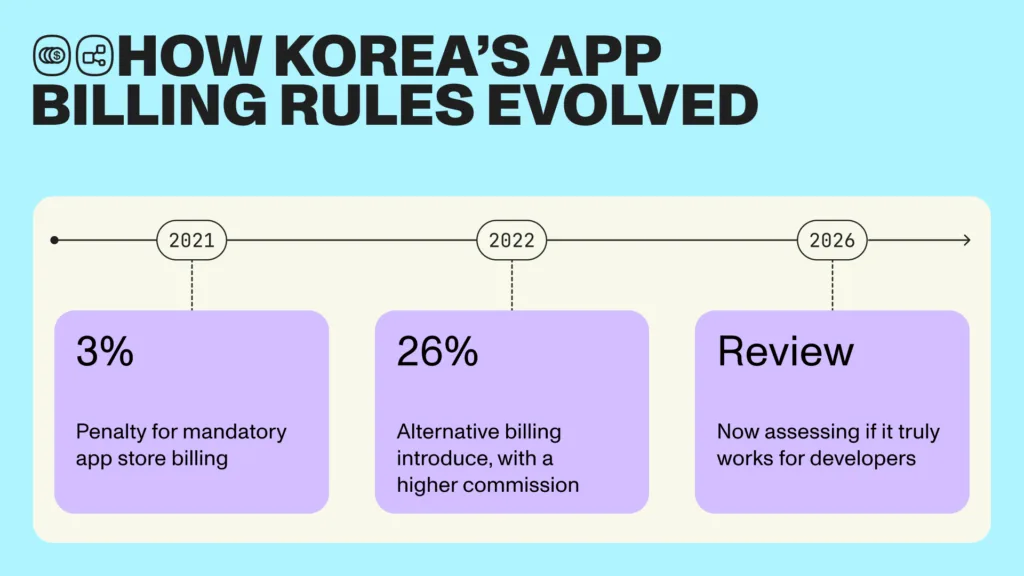
2021: South Korea amended its Telecommunications Business Act (TBA) to ban mandatory app store billing, with penalties of up to 3% of an app store operator’s revenue in South Korea for violations.
2022: Google and Apple introduced alternative billing, but charged fees of up to 26% on those transactions. Once payment processing fees were added, third-party billing offered almost no cost advantage over the original 30%. Google also blocked a KakaoTalk update after the messaging app introduced a link to cheaper web payment options. The regulator opened investigations, and by October 2023 had notified both companies of potential fines totalling up to KRW 68 billion.
2026: The KMCC assessed whether alternative billing was commercially viable in practice, rather than simply available to developers. Apple has disputed the ruling and is considering its legal options. Google has argued the decision does not account for payment policy changes announced in March 2026, which are part of a separate fee restructure scheduled to reach South Korea by 31 December 2026.
South Korea’s decision sits within a wider regulatory shift. The US, Australia, Indonesia, the EU, Japan and the UK have all taken action on platform commissions, external linking restrictions or mandatory billing, though each jurisdiction is pursuing different approaches and remedies. For publishers, this means navigating an increasingly fragmented landscape of local requirements governing fees, external links and payment arrangements.
What should game publishers prepare for in South Korea?
Four developments are worth watching:
1. New payment options are coming.
Apple and Google have three months from receipt of KMCC orders to implement changes. Google’s separate fee restructure is also scheduled for South Korea on 31 December 2026. If you’re operating in the market, review your payment arrangements now.
2. Fees will still shape your decisions.
The ruling doesn’t make external payments commission-free. The KMCC’s concern is whether fees make alternatives commercially unattractive, not whether app stores charge commissions at all. Look beyond headline platform rates to the total cost of each payment route: processing, compliance and settlement all count.
3. App review practices are under scrutiny.
The KMCC signalled the need for follow-up monitoring and flagged delays and lack of transparency for developers using alternative payments. If you rely on frequent updates, live ops or promotional events, that matters.
4. Further regulatory action is still on the table.
If revised terms still restrict developers’ ability to use alternative channels, the KMCC can step in again.
What this means for publishers beyond South Korea
As more markets move towards enforcing meaningful payment choice, publishers should consider how these changes could affect their monetisation strategies.
Three areas deserve attention:
- Reassess payment economics. Compare platform commissions, payment processing costs and operational expenses to determine whether alternative payment channels offer meaningful commercial benefits.
- Identify market openings. Each regulatory shift creates a window. South Korea, Japan, the US and the EU are all at different stages, pursuing different regulatory approaches.
- Build for flexibility. Publishers that can move between payment channels, adapt to local fee structures and stay compliant across jurisdictions will capture the most value from these changes.
The opportunity extends beyond gaining access to alternative payments. It’s about evaluating where, when and how those channels make commercial sense.
As a Merchant of Record across 80+ markets, Coda handles payments, tax, compliance, fraud and settlement so you can focus on where and how to grow. Whether that’s through Coda Links for out-of-app checkout flows, Coda Webstore for D2C storefronts, or Codapay for local payment coverage.
Ready to act on the shift? Talk to us.

Safira Pusparani
Government Relations Manager, APAC
Safira is a public policy professional with experience driving regulatory affairs, policy advocacy, and cross-border initiatives across Southeast…
Safira is a public policy professional with experience driving regulatory affairs, policy advocacy, and cross-border initiatives across Southeast…
© 2026 Coda Payments Pte. Ltd
Site Credits