E-commerce Infrastructure: The Real Cost and Engineering Effort to Build In-House
Jul 21 2026・8 mins

TL;DR: For digital content businesses, launching an out-of-app webstore is a powerful strategy to scale direct-to-consumer (D2C) revenue and retain higher margins. Coda Webstore helps publishers monetize better and more efficiently, without the operational complexity.
Introduction
Gaming publishers, SaaS platforms, OTT streaming providers, and creator economy applications typically find out that custom builds require managing highly fragmented backend systems. This includes continuous engineering cycles for global payment orchestration, cross-border tax calculation, international compliance, and fraud protection.
While initial frontend development may look manageable, the long-term operational cost is where the infrastructure burden grows. Utilizing an established platform like Coda Webstore eliminates this technical debt, delivering a faster launch, lower operational overhead, and a built-in global compliance infrastructure.
The ecommerce structure behind online webstores
For digital content businesses, ecommerce infrastructure refers to the backend systems that allow a company to sell digital goods, process payments, manage risk, stay compliant, and scale across markets.
For enterprise digital platforms, out-of-app monetization is a critical strategy for capturing higher margins and driving direct-to-consumer (D2C) growth. However, a truly global, multi-industry digital monetization system requires a complex backend infrastructure far beyond a standard web storefront.
To support scalable growth across diverse industries such as AAA gaming titles, recurring SaaS platforms, OTT video streaming, online dating apps, and EdTech platforms, an enterprise e-commerce architecture must natively orchestrate:
- Digital product catalogs
- Local and global payment methods
- Liveops, Promotions and bundles
- Multi-currency pricing
- Tax calculation and remittance
- Fraud detection and chargeback management
- Payment retry logic
Each of these components adds cost, complexity, and maintenance. A webstore may start as a growth initiative. But once it supports multiple markets, it becomes a serious infrastructure commitment.
The hidden cost to build a webstore in-house
Building a webstore internally usually gives companies direct control over the experience. But that control comes with a full stack of responsibilities. Every new market, payment method, tax rule, or fraud pattern adds more engineering work. Internal teams must maintain APIs, payment flows, and troubleshoot user issues.
Hidden Cost 1: Global Payment Orchestration & API Maintenance
A primary driver of technical debt in custom builds is the fragmentation of global payment networks. Relying strictly on traditional international credit card rails guarantees high cart abandonment rates in emerging digital economies. True global conversion is dependent on local alternative payment methods (APMs), including regional e-wallets, direct carrier billing (DCB), instant bank transfers, and local vouchers.
| The Payment Engineering Reality: |
|---|
| Integrating an alternative payment method is never a simple, one-off API deployment. Every local payment method requires a completely distinct integration pattern, unique webhook transaction status logic, specialized settlement/reconciliation workflows, and customized refund architectures. As your platform’s geographic footprint expands, internal teams find themselves trapped in an ongoing loop of maintaining and debugging disparate checkout APIs. |
How Coda Webstore helps:
Powered by Codapay, Coda Webstore bypasses this engineering fragmentation entirely. Through a single API integration, digital content providers gain access to over 400 local and global payment methods across more than 80+ markets. Coda manages the backend payment orchestration, API maintenance, and network routing updates natively, allowing your developers to focus on core features instead of payment infrastructure maintenance.
Hidden Cost 2: Tax, Compliance, and Fraud Systems
Calculating the initial cost to build an e-commerce storefront internally frequently overlooks the continuous operational costs of international compliance. Selling digital content globally exposes an enterprise to a hyper-fragmented web of cross-border tax regulations (VAT, GST, local digital sales taxes), shifting refund obligations, and strict data privacy mandates like PCI-DSS Level 1 and GDPR.
This is where the Merchant of Record (MoR) model becomes important. An MoR acts as the legal seller for transactions. In the context of a webstore, the MoR can take on key responsibilities related to payment processing, compliance, fraud, chargebacks, and reporting.
How Coda Webstore helps:
Coda Webstore has built-in MoR. It can support digital content businesses by reducing the operational load of selling globally. This allows publishers to scale their webstore without building every compliance process internally.
Hidden Cost 3: Engineering bandwidth
The true cost to build a webstore in-house cannot be measured strictly in upfront developer cycles; it must be calculated through opportunity cost. Every sprint cycle spent refactoring checkout logic or patching payments delays your core product roadmap:
| Gaming Publishers | Engineering diversion halts critical LiveOps content pipelines, player conversion tools, and in-game engagement features. |
| Saas & EdTech Platforms | Maintenance cycles actively stall core feature updates, platform performance enhancements, and user experience updates. |
| Creator Platforms & Entertainment Apps | Developer focus is pulled away from designing advanced creator tools, marketplace optimization, and audience engagement loops. |
That is why building a webstore in-house should be evaluated as a long-term allocation of engineering capacity, not just a development project.
How Coda Webstore helps:
Coda Webstore utilises AI capabilities to set up your webstore, that frees up the effort in the early stages, moving from an App Store, Steam Store, or Google Play Store link to a localized, conversion-ready webstore in minutes. Coda Webstore can also keep users engaged with bundles, purchase limits, and growth tools designed to drive conversion and loyalty. These tools allow publishers to better allocate their bandwidth to focus on improving or building content.
Build vs. Buy: The Enterprise Decision Framework
The structural issue is not whether a company can build an out-of-app storefront, many can. The real hurdle is whether it makes sense to consistently maintain every layer of the global infrastructure required to operate it.
To clarify the strategic tradeoffs between an in-house build and deploying turnkey monetization infrastructure, enterprise leadership can utilize the following framework:
| Evaluation Vector | In-House Build | Coda Webstore |
|---|---|---|
| Upfront Cost | Moderate to high initial engineering capital expenditure (CapEx). | Minimal setup overhead; rapid shift to efficient operational deployment. |
| Long-Term TCO | Compounding operational expense (OpEx) due to technical debt and API maintenance. | Predictable, scalable infrastructure costs linked to performance. |
| Control & Customization | Complete control, but accompanied by total maintenance and ownership. | Granular front-end UI/UX control combined with zero backend maintenance. |
| Speed to Market | Typically 6 to 12 months for enterprise-grade global readiness. | Minutes to weeks, deploying localized checkouts instantly. |
| Global Scalability | Requires consecutive, localized engineering projects per target region. | Infinite global scale across 80+ markets accessible on day one. |
| Risk & Liability | Internal legal and financial teams absorb 100% of tax and fraud liability. | Coda’s MoR model absorbs 100% legal, tax, and chargeback liability. |
| Core Roadmap ROI | Diluted due to ongoing engineering resource diversion. | Maximized; engineering velocity remains focused on core product innovation |
This evaluation matrix illustrates that the true complexity of D2C monetization is not found in the initial setup code. The compounding burden belongs entirely to the hidden operational layers.
Coda Webstore: Building ecommerce infrastructure with ease
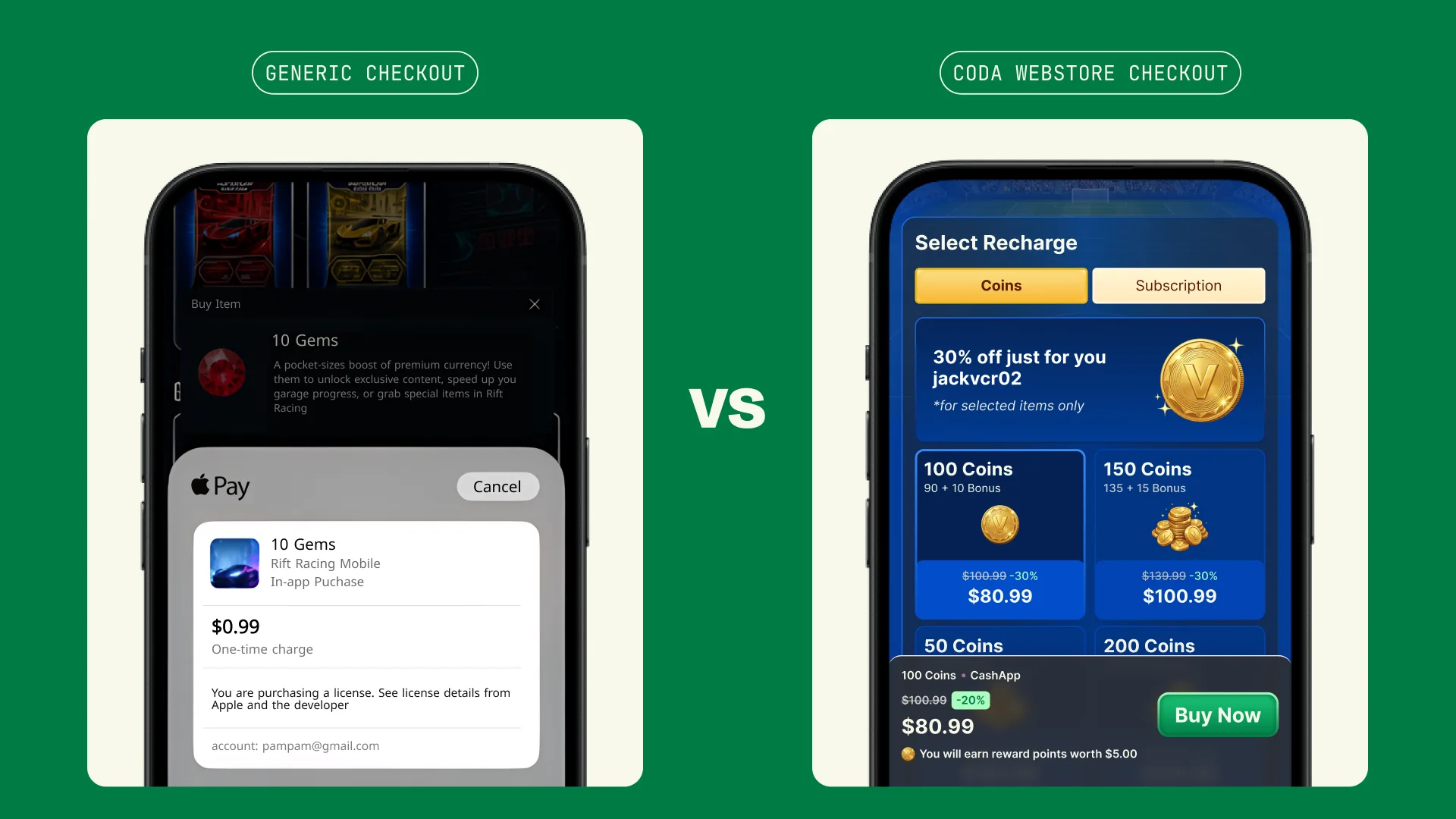
Coda Webstore gives digital content businesses a faster way to launch and scale without building the full infrastructure stack internally. Publishers can use Coda Webstore to create a customizable direct-to-consumer webstore with the core monetization infrastructure already in place.
Coda Links: Out-of-app monetization without the backend burden
Deploying a high-conversion storefront is only half of a successful out-of-app strategy; your users must also be able to navigate to it seamlessly. This is where Coda Links complements your webstore infrastructure as a specialized, fully compliant link-out solution.
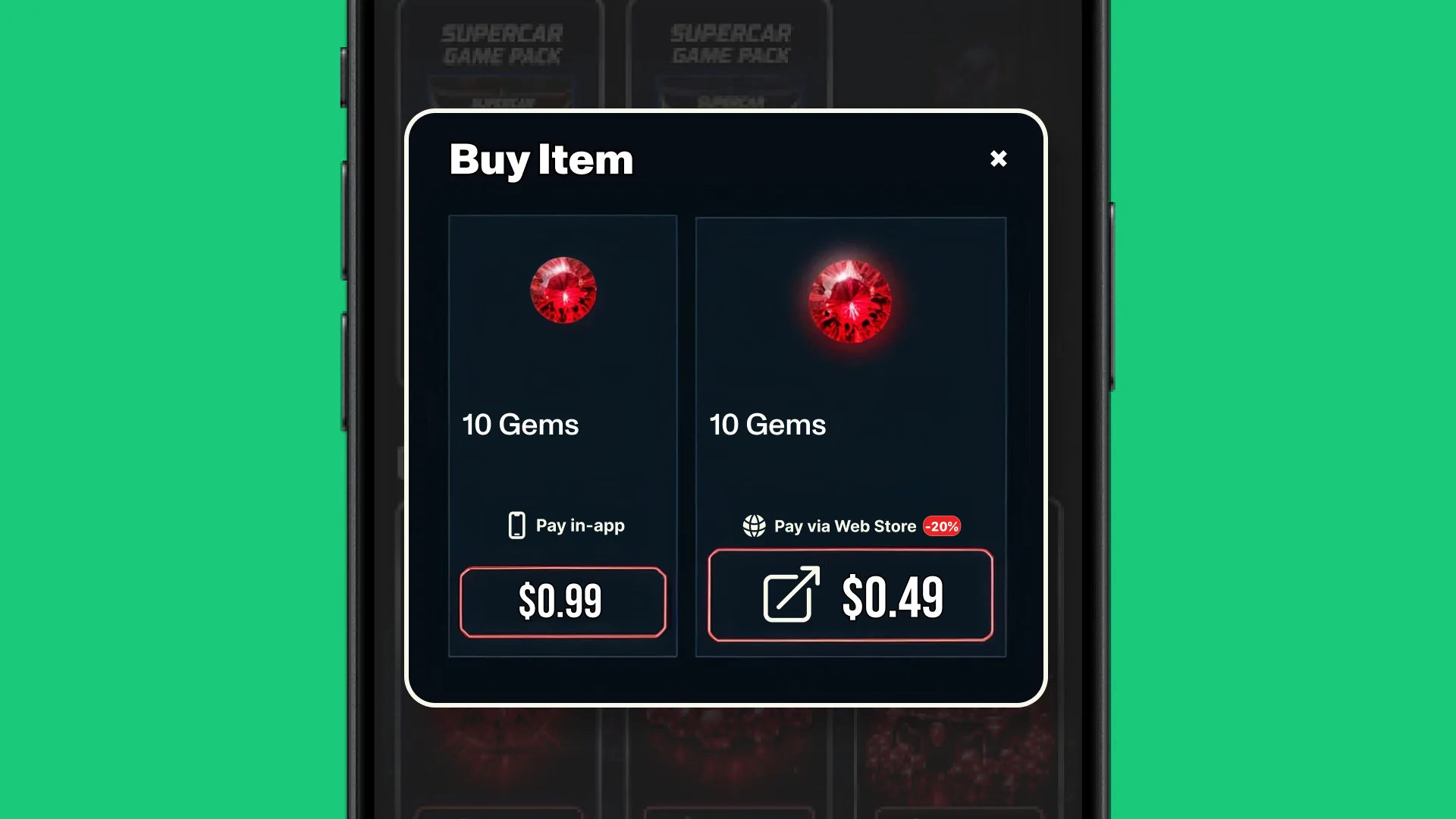
Acting as a frictionless bridge, Coda Links enables digital content companies to create and share secure payment links that route users out-of-app to direct payment lanes, safely bypassing traditional marketplace fee structures.
| Technical Metadata Mapping: |
|---|
| Coda Links does not merely forward a user to a standard homepage. It utilizes secure deep-linking architectures to map and pass critical technical parameters including Player/User IDs, precise SKU selections, and localized player profiles directly from the application environment straight to a customized brand checkout path. |
The platform is continuously A/B tested and fully updated to comply with Apple iOS and Google Android platform guidelines, regional regulations across the US and Japan, and foundational antitrust frameworks like the European Digital Markets Act (DMA).
By pairing Coda Webstore and Coda Links, global brands can maximize margin retention and unlock proven growth, demonstrated by major publishers securing up to a 38% revenue growth when shifting traffic to their webstore, and up to a 13x revenue expansion leveraging payment links without maintaining a dedicated D2C site.
When does building a webstore in-house make sense?
Building in-house can still make sense in certain situations. For example, if a company has a large dedicated commerce engineering team, deep payments expertise, internal tax and compliance operation, and ultimately, enough scale to justify ongoing infrastructure investment.
In these cases, the company may see it as a strategic asset worth maintaining their own webstore directly.
When does Coda Webstore make more sense?
Coda Webstore is a stronger fit when a company wants to launch and scale digital content without taking on the full burden of operational cost and engineering effort. It is especially relevant when the company needs to launch faster, reduce operational effort, and expand across markets seamlessly while reducing fraud exposure and offering more local payment methods.
For publishers, the goal should be to launch a webstore that can convert users, support local payments, and operate compliantly. Coda Webstore helps make that possible with less internal engineering effort.
Ready to grow? We’re ready to go.
Set up your Coda Webstore. Explore now.
Related

© 2026 Coda Payments Pte. Ltd
Site Credits