Gaming Payment Models: Choosing a Setup as a Game Publisher
Nov 11 2026・8 mins
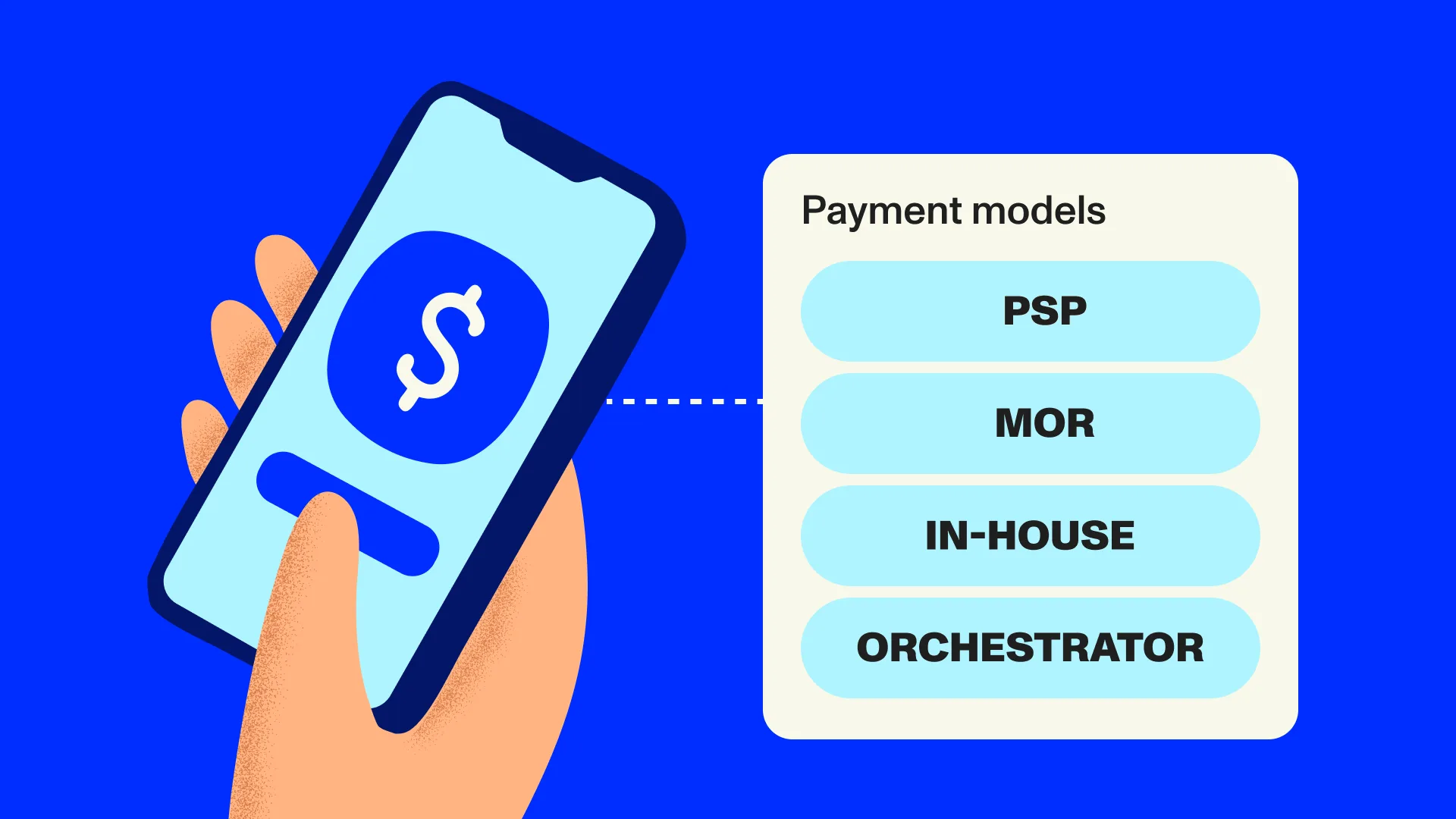
This is Part 2 of our gaming payments series. Part 1 covers the landscape and core challenges for mobile and video game publishers.
TL;DR: Game publishers can manage payments through four main setups:
- In-house payments: Best for established publishers with dedicated engineering, finance, and compliance teams that need extensive control over their payment infrastructure.
- Payment Service Providers (PSP): Suitable for publishers operating in a limited number of markets that want straightforward payment processing while retaining merchant responsibilities.
- Payment Orchestrator: Ideal for publishers managing multiple PSPs and payment methods that need centralized routing, optimization, and transaction visibility.
- Merchant of Record (MoR): Suitable for publishers expanding internationally that prefer a third party to act as the legal seller and manage defined tax, payment, and compliance responsibilities.
There is no universally superior gaming payment model. The right setup depends on a publisher’s transaction volume, market coverage, and desired level of control. Choosing the right gaming payment model affects operational costs, checkout performance, and international exposure. This guide compares the four approaches for video and mobile game publishers.
What are the four main gaming payment models?
The four gaming payment models differ primarily in how payment processing, legal responsibilities, compliance, and operational control are divided between the publisher and its payment partners.
- In-house payment infrastructure
An in-house payment setup is one in which a publisher builds and manages its own payment architecture, typically connecting directly to processors, acquiring banks, and regional payment providers.
The publisher oversees payment routing, fraud prevention, tax, and the integrations needed to serve its player base. This approach offers greater flexibility to design payment flows around game-specific requirements, but needs dedicated internal expertise and ongoing maintenance.
Importantly, payment transactions still require financial partners. Publishers must depend on acquiring banks, payment networks, and other regulated providers.
- Payment Service Provider (PSP)
A Payment Service Provider enables publishers to accept digital payments though an external payment infrastructure, while the publisher generally remains the legal seller. PSPs facilitate payment authorization, processing, and settlement. Some also offer fraud screening, reporting, dispute tools, and alternative payment methods.
This model reduces the need to develop the infrastructure from scratch, although the publisher typically retains responsibility for taxes, customer disputes, and the commercial obligations associated with each sale.
- Payment Orchestrator (PO)
A Payment Orchestrator connects multiple payment service providers through a centralized integration, helping publishers manage and optimize transactions across different payment networks. Rather than relying on one processor, publishers can route payments based on factors such as geography, payment method, performance, and cost.
An orchestrator simplifies managing multiple PSPs, but the publisher generally remains the legal seller and retains responsibility for tax, compliance, and financial liabilities.
- Merchant of Record (MoR)
A Merchant of Record acts as the legal seller of digital goods to the customer, taking responsibility for payments, tax, and regulatory obligations associated with those transactions.
An MoR typically handles payment collection, applicable tax calculation, refunds, and compliance within its supported markets. Publishers can therefore outsource significant parts of their global payment operations. However, the exact allocation of financial losses, customer support, and other responsibilities depends on the provider’s contract.
This guide focuses on the build-or-buy choice and how each model handles gaming’s payment challenges. For a feature-by-feature comparison of MoR, PSP and orchestrator, see our MoR vs PSP vs Payment Orchestrator guide.
How do gaming payment models address publisher pain points?
Each payment model handles gaming’s core payment challenges differently, especially when it comes to fraud exposure, transaction performance, and regional payment coverage.
Game publishers face five recurring gaming payments challenges: app store commissions, instant authorization, friendly fraud, card testing, and fragmented payment preferences.
The comparison below highlights which responsibilities remain with the publisher under each setup.
| Challenge | In-house | Payment Service Provider | Payment Orchestrator | Merchant of Record |
|---|---|---|---|---|
| App store commissions | Does not change or remove in-app fees | Does not change or remove in-app fees | Does not change or remove in-app fees | Does not change or remove in-app fees |
| Authorization and instant delivery | Publisher manages routing, payment confirmation, and fulfilment | PSP processes payments, publisher connects successful transaction to item delivery | Orchestrator manages supported routing while publisher remains responsible for fulfilment | MoR manages its payment flow; publisher remains responsible for fulfilment |
| Friendly fraud | Publisher manages disputes, evidence, and financial losses | Publisher generally carries losses, using any PSP dispute tools | Publisher manages disputes across PSPs | MoR handles disputes as seller |
| Card testing | Publisher builds or integrate bot detection and fraud screening | PSP may provide detection tools but publisher oversees risks | Orchestrator can coordinate fraud tools across PSPs | MoR manages fraud and chargeback controls |
| Regional payment fragmentation | Publisher integrates and maintains relevant local payment methods | Available payment methods depend on the regional coverage | Multiple PSP connections can expand local payment coverage through PO | MoR maintains multiple payment methods, depending on coverage |
Note: No model automatically guarantees higher authorization rates, zero fraud, or immediate fulfilment. These outcomes also depend on provider capabilities, implementation quality, and publisher’s backend.
Should game publishers build in-house or use a provider?
Building a gaming payments in-house is appropriate when a publisher has the technical resources and commercial reasons to maintain direct control over its payments. It does provide greater flexibility: being able to choose local payment partners directly, design transaction rules around performance, negotiate directly with payment providers, and maintain overall control over vendor selection.
However, that’s just the beginning. What does running gaming payment in-house actually involve?
Every new market can introduce additional payment methods, local regulations, tax obligations, currencies, and settlement requirements. Publishers must also coordinate dispute management, fraud monitoring, and payment provider integrations internally.
These responsibilities often extend beyond tech to finance, legal, operations, and customer support. For a publisher with sufficient scale, this investment may be justified by potential long-term efficiencies. But for others, building the same capabilities can divert resources from game development and player acquisition.
Which gaming payment model fits each publisher stage?
The best gaming payment setup changes as a publisher grows, particularly when its player base expands across markets and its payment operations become more complex. Most first-time publishers start with a PSP or MoR, growing publishers move to a MoR or orchestrator as they expand, and large multi-title publishers may build in-house or use an orchestrator alongside a MoR.
| Publisher stage | Recommended starting point | Why it fits |
|---|---|---|
| First launch / indie studio | PSP or MoR | PSP for simple domestic payments; MoR when international tax and compliance are immediate concerns |
| Growing publisher expanding internationally | MoR or PO | MoR simplifies cross-border operations; PO suits teams already managing several PSPs |
| Large, multi-title publisher | In-house or MoR | Supports direct commercial control, specialized routing, and wider market coverage |
Does choosing a payment model reduce app store commissions?
No payment model automatically reduces app store commissions on purchases purchased through native in-app billing. Whether a publisher uses an in-house payment system, PSP, PO, or MoR, transactions completed through Apple or Google’s native billing systems remain subject to applicable platform fees and policies.
The opportunity to change that comes from where the transaction takes place, not just which provider processes it.
In-app payments vs out-of-app webstores
Out-of-app monetization allows eligible publishers to offer digital goods through external checkout or branded webstores, subject to applicable market and platform rules.
A webstore can give publishers additional control over pricing, promotions, and checkout design, while creating an alternative to relying exclusively on in-app purchases. Any of the four payment setups can support a web-based sales channel. The choice is how operations and the responsibilities are managed once the publisher establishes the web channel.
What should publishers ask before choosing a provider?
Publishers should assess payment providers based on legal responsibility, market coverage, payment performance, risk, and technical requirements of their games and content.
Besides the compliance aspect, a provider should be evaluated against the publisher’s actual operating requirements, not solely the number of payment methods advertised or the headline transaction fee. Choosing a gaming payment model establishes who manages the transaction, but publishers must look into how the infrastructure performs in practice.
The right model is one that aligns with a publisher’s internal practice, market ambitions, and desired control. That may mean managing it internally, working with a provider or combining multiple approaches as the business scales.
Frequently Asked Questions (FAQs)


© 2026 Coda Payments Pte. Ltd
Site Credits