AI Shopping Agents Are Changing the Game of Top-ups
Adam Hu, SVP, Product・Nov 04 2026・6 mins
TL;DR
- A new sales channel. Players are starting to buy through AI assistants, which gives publishers a new route to direct sales.
- Agent-ready stores win the sale. Coda WebstoreMCP lets agents find the right product, confirm the price and complete checkout on your webstore.
- Repeat purchases get easier. Player accounts and saved payments let agents reuse a player’s details on the next purchase, with the player’s approval.
- No rebuild needed. Both capabilities work with your Coda webstore or your existing store running Codapay.
Players are already asking AI assistants to find and buy digital content for them. For game publishers, that’s a new channel for direct sales, as long as the purchase can happen on their own webstore.
What is agentic commerce?
Agentic commerce is when an AI agent finds, compares and buys products on a customer’s behalf, with the customer’s approval. For game publishers, it means a player can ask an AI assistant to top up a game, and the purchase can be completed on the publisher’s own webstore.
Here is how a purchase works:
- The agent finds the right product, such as an amount of in-game currency.
- The agent maps out which player details the game needs, such as a player ID or server, and obtains the final price.
- The player reviews and approves the purchase.
- The agent completes the checkout and verifies that the item is delivered.
AI agents – an ideal fit for game top-ups
The forecasts are bullish. McKinsey estimates that AI agents could orchestrate between $3 trillion to $5 trillion in global sales by 2030, and Bain expects them to account for 15% to 25% of US ecommerce. Game top-ups match Bain’s view that precise purchases will move to agents first; McKinsey’s view is that recurring purchases suit agents well. Players know exactly what they want, and many buy the same currency or items over and over again.
Over a decade ago, many businesses were still debating whether mobile commerce was worth the investment. Agentic commerce may be at a similar growth stage, with both McKinsey and Bain advising merchants to prepare a strategy and ready the infrastructure now. Publishers who prepare now are better placed to win volumes in an era of agent-driven purchases.
At Coda, our approach starts with making your store easy for agents to buy from, then making each repeat purchase easier and faster.
Customer top-up for MLBB using the K PLUS e-wallet through an AI assistant
1. Capture agent-driven sales with Coda WebstoreMCP
AI agents can already shop on webstores much as people do: they browse product pages, fill in forms and move through checkout. Game top-ups make this harder. To buy in-game currency, an agent has to find the right product, figure out which player details that the game needs, such as a player ID or server, and confirm the final price. In many cases, the agent compares between multiple stores before making the purchase; the store that is able to share a confirmed price and complete the checkout often gets the final sale. With the player’s approval, the agent completes checkout and checks that the item was delivered. On pages built for people, a layout change, a login screen or an unexpected prompt can stop the purchase.
WebstoreMCP gives agents a direct way to work with your store. It’s built on Model Context Protocol (MCP), an open standard that lets AI agents use digital tools and services, so the agent asks the store directly for the relevant information instead of crawling through all the pages. It finds available products, learns about the required player details and receives a final quote including fees and taxes. Once the player approves, the agent completes the checkout and verifies payment and delivery status.
How WebstoreMCP simplifies the purchase journey
| Step | Without WebstoreMCP | With WebstoreMCP |
| Find the product | The agent reads pages to identify the correct SKU | The store provides products, prices and availability directly |
| Player details | The agent interprets the required fields from a form | The store specifies the details needed for each product |
| Price | The agent reads the final amount from checkout | The store provides a quote including fees and taxes |
| Checkout | The agent navigates checkout screens and prompts | The agent uses store tools after receiving player approval |
| Delivery | The agent checks a confirmation page or email | The agent retrieves payment and delivery status directly |
WebstoreMCP runs on your existing catalog and checkout, so agents see the same products and prices as players on your webstore. When several stores sell the same digital content, the store where an agent can reliably finish the purchase is better placed to win the purchase.
2. Turn first-time purchases into repeat sales
Players often return for the same products, with the same game details and payment method. Coda is building player accounts and saved payments so agents can reuse that information. With the player’s permission, an agent can draw on saved game details, purchase history and payment methods for future purchases. Publishers can use their existing customer accounts or Coda Accounts.
The agent guides the player through account registration within the conversation, and the player completes verification and approvals.
What are agentic payments?
Agentic payments are payments that an AI agent prepares or completes on a customer’s behalf, with the customer’s approval. This is applicable across different payment methods, including e-wallets and cards. Players who choose to save a payment method can enter their details on Coda’s secure card collection page, and the agent receives a reference that can be used for future purchases with the player’s approval. Throughout the process, the agent never sees the card number.
Players get a faster checkout and stay in control of every transaction, and your webstore becomes the natural place for their next purchase.
Bring agentic commerce to your existing store
No need to rebuild your commerce setup. Coda’s capabilities work with the stores, catalogs and payment systems you already use, and you can adopt them individually or together.
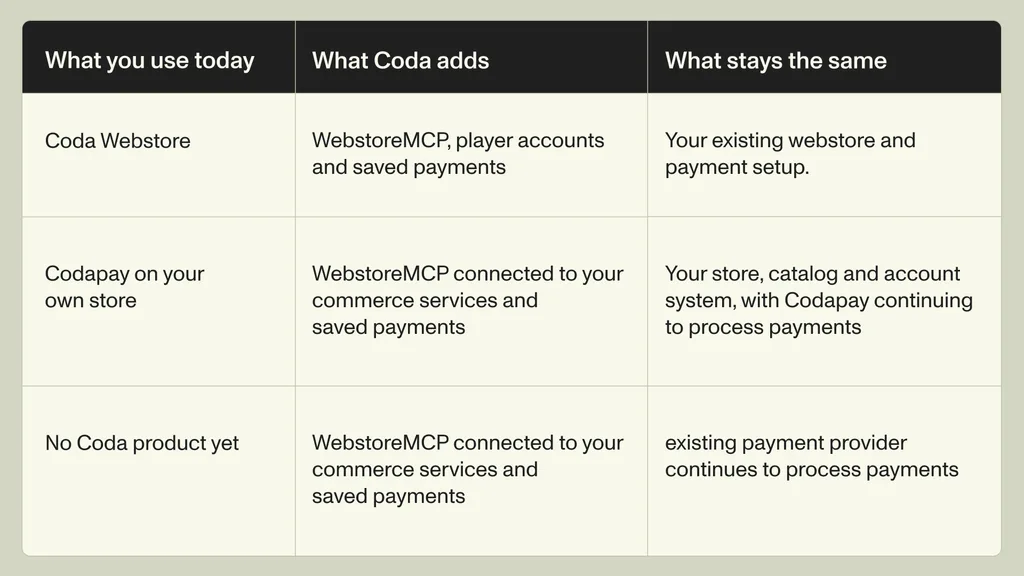
With every option, keep control of your direct sales, player relationships and infrastructure.
Get your store ready for what’s next
As more players shop through AI assistants, the publishers whose stores are easiest for agents to buy from will be best positioned to grow direct sales and repeat purchases. Coda is building the tools to support your growth, from the first agent-driven purchase to the many that follow.
Curious what agentic commerce can do for your business?
Talk to our team today.

Adam Hu
SVP, Product
Product leader in global payments, digital commerce, and experimentation. Adam Hu is SVP of Product at Coda, where he leads product across global…
Product leader in global payments, digital commerce, and experimentation. Adam Hu is SVP of Product at Coda, where he leads product across global…

© 2026 Coda Payments Pte. Ltd
Site Credits