


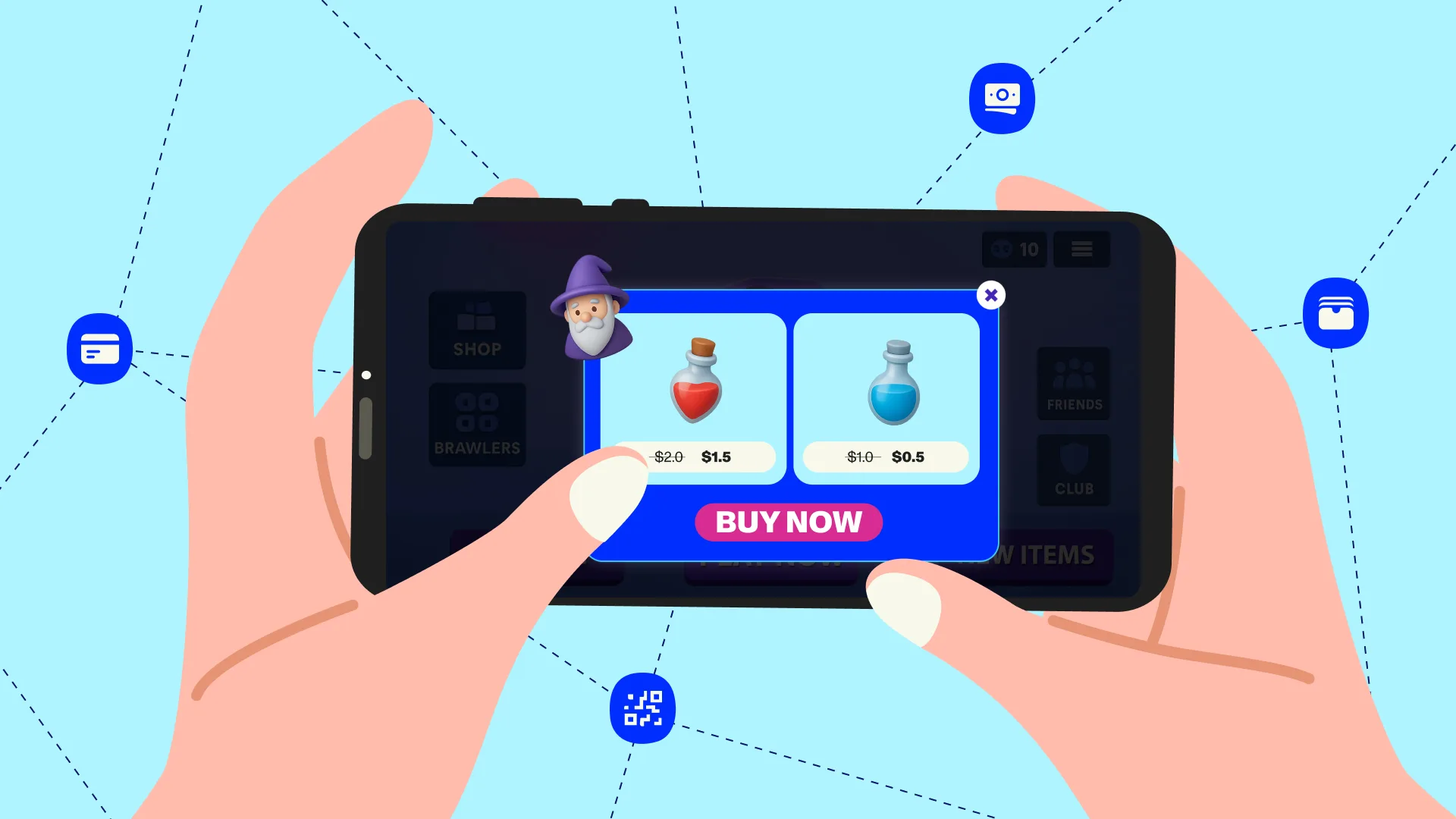
For most game publishers, the goal is clear: deliver frictionless payments so players can spend instantly and safely, no matter where they are in the world. It’s natural to assume that integrating a standard payment gateway is the right starting point. After all, most SaaS products, web services, and e-commerce experiences rely on gateways to process transactions.
But gaming is different. The deeper you go, the more you discover the hidden complexities that typical payment gateways aren’t designed to solve:
- Multiple payment preferences
- Microtransaction behaviour
- Regional regulations
- Fraud risks
- Real-time operational demands
This guide breaks down what developers should know before committing to a global gaming payment gateway integration and why purpose-built payment solutions for games are changing the way games scale worldwide.
WHAT is a payment gateway?
In simple terms, a payment gateway is a system that authorizes and processes online transactions securely. In most industries, gateways act as the backbone of online checkout. They allow publishers to:
- Accept a variety of payment methods
- Securely tokenize and transmit payment details
- Support recurring or one-off transactions
- Handle basic fraud screening
For early-stage games or single-market titles, payment gateway integration is often enough. Developers naturally turn to gateways because they offer quick initial setup and ready-made APIs. The initial costs are also usually low with minimal operational overload, making it a good start to accept major global payment methods easily.
But the moment a game grows beyond a single region or when it depends heavily on microtransactions, the limitations start to show.
Realities Behind Global Payment Gateway Integration for Games
Global gaming paints a very different reality when it comes to payments. The moment you expand to new regions, handle microtransactions, or run major in-game events, you begin to encounter some challenges:
- Fragmented payment networks. Each gateway supports a different set of methods and markets. This leads to multiple integrations, more maintenance, and inconsistent performance.
- Limited local payment coverage. Popular gaming markets such as SEA, LATAM, MENA dominantly use e-wallets, bank transfers, and alternative payments that some gateways don’t support.
- Event-driven traffic spikes. Sales, drops, and updates create massive concurrency peaks that many gateways aren’t optimized for.
- Manual tax & compliance handling. Developers must manage GST, VAT, digital services tax, and invoicing regulations per market.
- Higher chargeback & fraud sensitivity. Gaming’s low-value, high-volume transaction patterns complicate fraud controls.
- Additional costs. What starts as a simple payment gateway integration may grow into a multi-layer payments infrastructure. Costs add up as you scale and require technical or regulatory expertise.
Why Games Need Purpose-built Payment Solutions
Games don’t monetize like typical online businesses. Players buy in the moment, during a match, mid-event, or right before a limited-time drop. These microtransactions need to be authorized instantly, every time.
When payments lag or fail, revenue is lost on the spot. That’s the fundamental mismatch with generic payment gateways: they’re designed for checkout flows, not real-time in-game spending.
Put simply, modern games need payments built for speed, coverage, and reliability. Purpose-built gaming payment solutions close the gaps so developers can focus on building great games, not managing payment infrastructure.
Rethinking Global Gaming Payments: The Coda Way
A Merchant of Record (MoR) is more than a payment processor, it’s the legal and operational entity that manages the entire payment lifecycle on behalf of a game publisher. Taxes, invoicing, chargebacks, compliance, settlement: the MoR absorbs it all.
That’s what Coda does as MoR, providing global coverage, managing regulatory obligations end to end, and giving publishers a faster, cleaner path to scale.
The biggest advantage is reach. With Coda, publishers can integrate and tap into a global footprint, unlocking 400+ local payment methods without needing local entities, licenses, or tax registrations. This single integration dramatically reduces engineering complexity, operational overhead, and the time required to expand into new markets.
Coda also removes many of the challenges that make traditional gateway-led setups so difficult to scale. You no longer deal with multiple integrations, fragmented payment coverage, or reconciliation headaches.
Payment Gateway vs. MoR
| Category | payment gateway | coda merchant of record |
|---|---|---|
| Integration Model | Single or multiple integrations per method/region | One integration for all methods and markets |
| Payment Coverage | Limited, varies by gateways | Full local and global coverage, unified |
| Regulatory Compliance | Publishers handles tax and licensing | Coda manages all compliance end-to-end |
| Player Experience | Dependent on payment gateway performance | Optimized for game-specific UX and microtransactions |
| Operational Overhead | High as market scale | Minimal as Coda handles ops, reporting, and settlement |
| Time to Market | Slow for new regions | Instant activation through Coda’s MoR’s existing footprint |
| Cost Structure | Lower initial cost, higher long-term operational cost | Predictable all-in costs, lower engineering burden |
Integrating a payment gateway is a great first step for early-stage games. But as your title grows across markets, devices, and player segments, the complexities multiply with compliance challenges, local payment coverage, and more.
Coda as a MoR is built specifically for games and provides a faster and more scalable approach to global monetization. With one integration, developers can enter 70+ markets worldwide, unlock 400+ local payment methods, and deliver a seamless experience that keeps players spending and coming back.
Ready to grow your game? Sign up now.

Jan 16 2026
4 mins


Oct 24 2025
2 mins


Sep 25 2025
2 mins

© 2026 Coda Payments Pte. Ltd
Site Credits